
Which Laser Treatment Is Best for Acne Scars?
A Complete Guide to Laser Acne Scar Removal, Skin Resurfacing, and Smoother-Looking Skin
Acne can leave lasting changes in the skin even after breakouts have cleared. Some people develop small depressions, uneven texture, raised scars, or dark marks that make the complexion appear less uniform.
If you are wondering which laser treatment is best for acne scars, the answer depends on the type of scarring, its severity, your skin tone, and the results you want to achieve.
Laser treatments can improve the appearance of certain acne scars by resurfacing damaged skin and encouraging collagen remodeling. However, different laser technologies work in different ways, and no single device is ideal for every scar type.
Fractional CO2 lasers, Erbium YAG lasers, and nonablative fractional lasers are among the technologies used for acne scar resurfacing. Other devices, including IPL and Q-Switch YAG, may be more relevant to certain discoloration concerns than deep, depressed scars.
At Dr. Lift Spa in Grapevine, Texas, patients from Southlake and nearby communities can explore available skin treatment options through a personalized consultation.
Understanding the differences between acne scar treatments can help you make informed decisions about your skin.
What Causes Acne Scars?
Acne scars develop when inflammation damages the skin’s supporting structures.
During an inflammatory breakout, the skin attempts to repair affected tissue. If the healing process produces too little collagen, depressed scars may form.
If excessive collagen develops, raised scars may appear.
Several factors can influence the likelihood of scarring:
Severe inflammatory acne
Deep acne nodules or cysts
Delayed treatment of inflammatory breakouts
Picking or squeezing acne lesions
Individual healing response
Genetic susceptibility
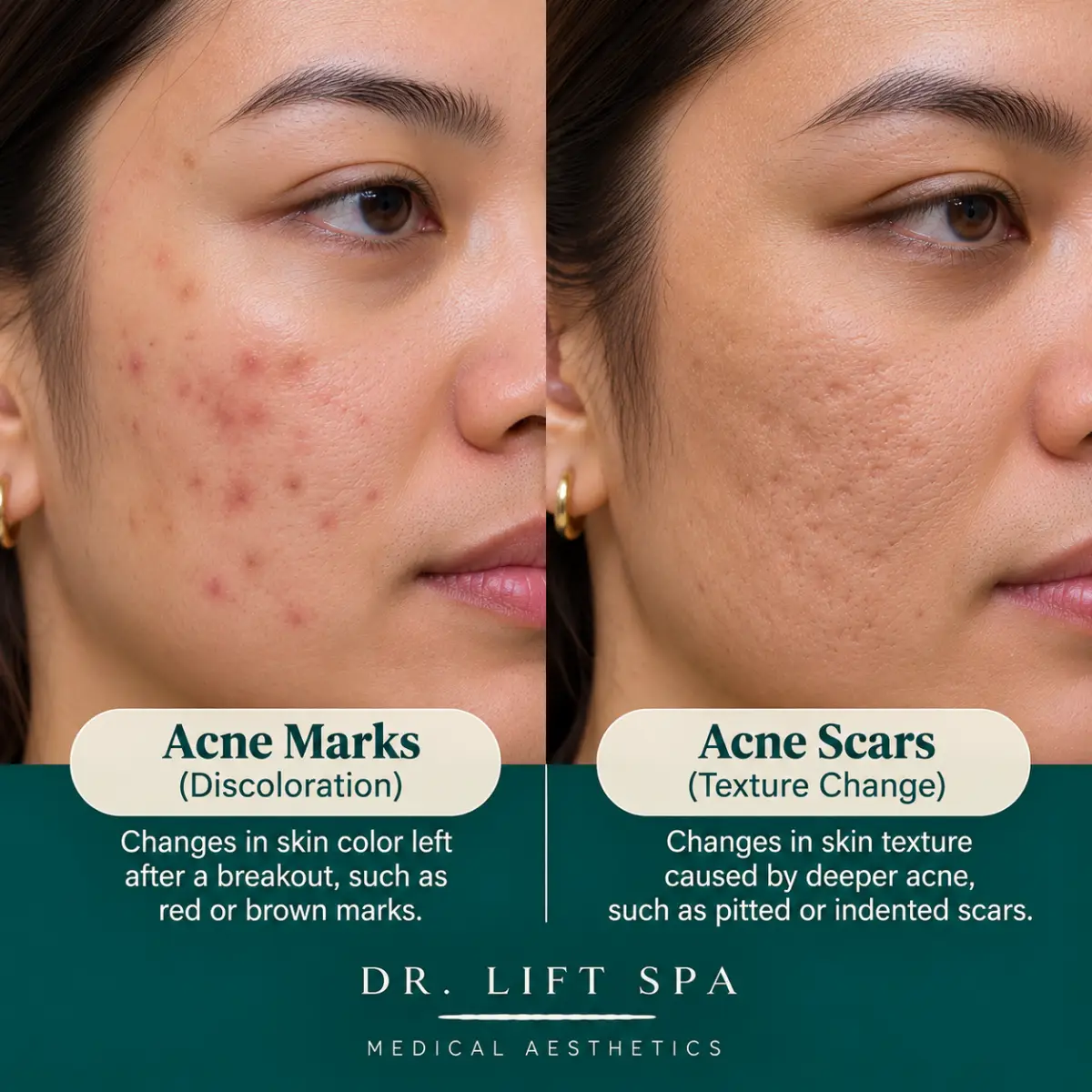
Not every mark left by acne is a permanent scar.
Some red or brown marks are changes in skin color rather than structural scarring.
Identifying the difference is important because pigmentation and textural scars may require different treatments.
Understanding the Different Types of Acne Scars
Before choosing the best laser treatment for acne scars, a qualified provider should identify the scar type.
1. Ice Pick Acne Scars
Ice pick scars are narrow, deep depressions that extend into the skin.
They often appear as small, sharply defined openings.
Because these scars extend deeply, resurfacing alone may not provide sufficient improvement.
Selected procedures such as punch excision or TCA CROSS may be considered by appropriately trained clinicians.
2. Boxcar Acne Scars
Boxcar scars are round or oval depressions with relatively defined edges.
They may be shallow or deep.
Shallow boxcar scars may respond to resurfacing procedures, while deeper scars sometimes require a combination of techniques.
3. Rolling Acne Scars
Rolling scars create broad, uneven depressions that give the skin a wavy appearance.
Some rolling scars are attached to deeper tissue by fibrous bands.
These tethered scars may benefit from subcision, sometimes combined with resurfacing.
4. Hypertrophic Acne Scars
Hypertrophic scars are raised areas caused by excessive collagen production.
They require a different treatment approach from depressed scars.
5. Keloid Scars
Keloids are raised scars that extend beyond the original area of skin injury.
Treatment may involve injections, silicone therapy, or selected procedures under specialist guidance.
6. Post-Acne Dark Spots
Post-inflammatory hyperpigmentation causes darker areas after inflammation.
These marks are not necessarily permanent structural scars.
Treatment may involve sun protection, topical therapies, or carefully selected procedures.
7. Post-Acne Red Marks
Post-inflammatory erythema produces pink or red discoloration after acne.
Vascular-targeting treatments may be considered for selected cases.
Which Laser Treatment Is Best for Acne Scars?
For many depressed acne scars, fractional ablative lasers are among the established resurfacing options.
However, the best treatment depends on the specific scar type.
Fractional CO2 Laser
Often considered for selected moderate or more pronounced atrophic acne scars.
Erbium YAG Laser
May improve depressed scars and uneven texture through controlled resurfacing.
Nonablative Fractional Laser
May provide gradual improvement with less surface disruption than ablative resurfacing.
IPL Treatment
May help selected post-acne redness or pigmentation concerns but is not generally the preferred treatment for deep depressed scars.
Q-Switch YAG Laser
May be used for selected pigment-related concerns. Conventional Q-switched pigment treatments are not generally the primary choice for correcting deep acne scar texture.
The best option is determined by the diagnosis, expected benefits, recovery requirements, and individual risk factors.
1. Fractional CO2 Laser for Acne Scars
Fractional carbon dioxide laser resurfacing uses laser energy to create microscopic treatment zones in the skin.
Ablative fractional CO2 treatment removes small columns of tissue and generates controlled thermal effects.
As the skin heals, collagen remodeling can help improve the appearance of selected depressed scars.
Potential Benefits
Improves certain depressed acne scars
Addresses uneven skin texture
Encourages collagen remodeling
May soften the appearance of some scar edges
Can provide meaningful improvement in appropriately selected patients
What Types of Scars May Respond?
Fractional CO2 may be considered for selected boxcar and rolling scars.
Deep ice pick scars may require additional targeted procedures.
What About Recovery?
Ablative fractional CO2 treatment can involve:
Redness
Swelling
Crusting
Skin sensitivity
Temporary interruption of usual skin care
Risk of post-inflammatory hyperpigmentation
Recovery varies with treatment intensity and individual healing.
Important: Fractional CO2 is discussed here for educational comparison. Its availability at Dr. Lift Spa has not been confirmed.
2. Erbium YAG Laser for Acne Scars
Erbium YAG is a resurfacing laser that commonly operates at a wavelength of 2940 nm.
It is strongly absorbed by water in the skin, allowing controlled removal of superficial tissue.
Depending on the device and settings, Erbium YAG can be used for different resurfacing applications.
How Does Erbium YAG Work?
The laser delivers energy to water-containing skin tissue.
This can remove selected superficial layers while stimulating a wound-healing response.
As the skin heals, collagen remodeling may improve the appearance of certain acne scars.
Potential Benefits
Improves selected depressed acne scars
Smooths some uneven skin texture
Softens the appearance of certain scar edges
Supports collagen remodeling
Offers controlled resurfacing options
What Types of Acne Scars May Respond?
Erbium YAG may be considered for selected shallow boxcar scars, rolling scars, and other appropriate atrophic scars.
Deep, narrow scars may require additional procedures.
Erbium YAG Recovery
Possible reactions include:
Redness
Swelling
Tenderness
Temporary crusting
Skin sensitivity
Pigment changes
The intensity of resurfacing determines how much recovery may be required.
Is Erbium YAG Better Than CO2?
Not necessarily.
Some studies suggest fractional CO2 can produce greater improvement in selected atrophic acne scars, but it may also involve more discomfort and downtime.
Erbium-based treatments may offer a different balance of resurfacing, tolerability, and recovery.
Neither option is universally superior.
3. Nonablative Fractional Laser for Acne Scars
Nonablative fractional lasers deliver controlled energy into the skin while generally preserving the surface to a greater extent than ablative resurfacing.
They create microscopic treatment zones that stimulate collagen remodeling.
Examples include certain 1540 nm and 1550 nm fractional laser systems.
Potential Benefits
Improves selected mild to moderate atrophic scars
Encourages collagen remodeling
Generally involves less surface disruption than ablative resurfacing
May offer a different recovery profile
Can be considered for some patients who prefer a less intensive approach
Limitations
Nonablative fractional treatments may require multiple sessions.
Results can be gradual, and deeper scars may respond less than superficial scars.
Who May Consider This Option?
Patients with selected atrophic scars who want to discuss treatment options with potentially less downtime than ablative resurfacing.
Device selection and treatment suitability require professional assessment.
4. Q-Switch YAG Laser for Acne Scars
Q-Switch YAG generally refers to a Q-switched Nd laser.
This technology delivers concentrated laser energy in very short pulses.
It is commonly associated with certain pigmented lesions and tattoo pigment treatments.
Can Q-Switch YAG Improve Acne Scars?
Conventional Q-switched pigment-targeting treatments are not generally the primary treatment for deep, depressed acne scars.
However, certain laser protocols may be investigated or used for selected skin concerns.
The exact device and operating mode matter.
What About Post-Acne Pigmentation?
Some post-acne pigmentation concerns may be evaluated for pigment-targeting laser treatments.
However, post-inflammatory hyperpigmentation can worsen after inappropriate laser exposure.
Q-Switch YAG vs Erbium YAG
Q-Switch YAG: Primarily associated with short-pulse pigment-targeting applications.
Erbium YAG: Used for controlled skin resurfacing and selected textural acne scars.
These technologies should not be considered interchangeable.
5. IPL for Acne Scars
IPL stands for Intense Pulsed Light.
Although frequently called IPL laser treatment, IPL is not technically a laser.
It delivers filtered broad-spectrum light that can interact with selected pigment and vascular targets.
Can IPL Treat Acne Scars?
IPL may help with some post-acne discoloration, including selected redness-related concerns.
However, it is not generally the preferred treatment for correcting deep depressions caused by collagen loss.
When Might IPL Be Considered?
IPL may be discussed for:
Selected post-acne redness
Certain superficial discoloration
Uneven-looking skin tone
Other suitable pigment or vascular concerns
IPL vs Laser Resurfacing
IPL primarily targets selected light-absorbing structures.
Laser resurfacing technologies can directly address skin texture and stimulate collagen remodeling.
A patient with both discoloration and depressed scars may require a treatment plan addressing these concerns separately.
Best Laser Treatment for Acne Scars by Scar Type
| Acne Scar Type | Treatment Approaches Often Considered |
|---|---|
| Ice pick scars | TCA CROSS, punch techniques, sometimes adjunctive resurfacing |
| Shallow boxcar scars | Fractional CO2, Erbium YAG, nonablative fractional laser |
| Deep boxcar scars | Selected resurfacing combined with targeted procedures |
| Rolling scars | Subcision, sometimes combined with fractional resurfacing |
| Raised scars | Scar-directed injections, silicone therapy, selected lasers |
| Post-acne red marks | Selected vascular lasers or IPL |
| Post-acne brown marks | Sun protection, topical treatments, selected pigment-directed procedures |
These are general treatment categories, not individualized recommendations.
How Does Laser Treatment Improve Acne Scars?
Laser resurfacing can improve selected acne scars by changing the skin’s surface and encouraging tissue remodeling.
Step 1: Controlled Energy Delivery
The device delivers energy to selected skin structures.
Step 2: Microscopic Treatment Effects
Depending on the technology, the laser may remove superficial tissue or create controlled thermal treatment zones.
Step 3: Wound-Healing Response
The skin begins repairing the treated areas.
Step 4: Collagen Remodeling
Over time, collagen and other structural components may reorganize.
Step 5: Gradual Texture Improvement
Certain scars may become shallower or less noticeable.
However, lasers do not guarantee complete removal of acne scars.
7 Potential Benefits of Laser Treatment for Acne Scars
1. Smoother-Looking Skin Texture
Selected resurfacing procedures may soften uneven skin surfaces.
2. Reduced Appearance of Depressed Scars
Collagen remodeling may make some atrophic scars less noticeable.
3. Improved Scar Edges
Resurfacing may soften certain sharply defined scar borders.
4. Individualized Treatment Depth
Different laser technologies and settings allow providers to address selected treatment targets.
5. Collagen Remodeling
Some laser treatments stimulate structural changes during healing.
6. Combination Treatment Possibilities
Laser resurfacing may be combined with other scar-directed procedures when appropriate.
7. Long-Term Structural Improvement
Some improvements in scar appearance may persist after healing, although results vary and new acne can create additional scars.
Laser Treatment vs Microneedling for Acne Scars
Both laser resurfacing and microneedling may improve selected atrophic acne scars.
However, they work differently.
Laser Treatment
Uses controlled light energy to resurface or thermally treat selected skin tissue.
Microneedling
Uses fine needles to create controlled micro-injuries that stimulate collagen remodeling.
Which Is Better?
Some more intensive laser treatments may produce greater improvement in selected scars but involve more downtime or pigment-related risks.
Microneedling may offer a useful alternative for certain patients, including some individuals with darker skin tones.
The most appropriate option depends on scar type, skin tone, recovery preferences, and professional assessment.
Laser Treatment vs PRP for Acne Scars
Platelet-rich plasma, or PRP, is prepared from a patient’s blood.
It contains concentrated platelets that release growth factors involved in tissue repair.
PRP may be used as an adjunct to selected acne scar procedures.
Laser Treatment
Directly treats skin tissue through controlled energy delivery.
PRP
May be used alongside certain procedures to support treatment outcomes.
Can They Be Combined?
Some clinicians combine PRP with resurfacing or microneedling.
However, treatment combinations require individualized assessment, and evidence varies by protocol.
PRP alone should not be assumed to correct deep acne scars.
Can Laser Treatment Completely Remove Acne Scars?
Complete scar removal is not a realistic guarantee.
Laser treatment may improve the appearance of certain scars, but residual texture changes can remain.
Results depend on:
Scar type
Scar depth
Skin tone
Treatment technology
Provider technique
Number of sessions
Individual healing response
Previous treatments
Patients should aim for realistic improvement rather than expecting every scar to disappear.
Who Is a Good Candidate for Laser Acne Scar Treatment?
Laser resurfacing may be considered for individuals with certain established acne scars.
Individuals Who May Benefit From Evaluation
Adults with depressed acne scars
People with uneven skin texture after acne
Individuals with selected boxcar or rolling scars
Patients interested in collagen-remodeling treatments
People who understand recovery requirements
Individuals with realistic expectations
Who May Need Additional Precautions?
Laser treatment may need to be delayed or modified for people with:
Active inflammatory acne
Active skin infection
Recent sunburn or tanning
Certain medical conditions
A history of abnormal scarring
Increased risk of post-inflammatory hyperpigmentation
Relevant medication use
Difficulty following aftercare instructions
Patients with darker skin tones may face increased pigment-related risks with certain ablative lasers.
A qualified provider should evaluate individual suitability.
What Happens During a Laser Acne Scar Consultation?
Step 1: Identify the Scar Type
The provider evaluates whether the skin changes are ice pick, boxcar, rolling, raised, or pigment-related.
Step 2: Assess Skin Characteristics
Skin tone, sensitivity, pigmentation history, and previous treatments are reviewed.
Step 3: Discuss Medical History
The provider reviews relevant conditions, medications, and healing concerns.
Step 4: Review Treatment Options
Different resurfacing and non-resurfacing approaches are discussed.
Step 5: Explain Risks and Recovery
The provider explains potential benefits, limitations, complications, and downtime.
Step 6: Develop a Treatment Plan
An individualized approach may involve one treatment or a combination of procedures.
What Happens During Laser Treatment for Acne Scars?
The exact process depends on the technology being used.
Skin Preparation
The treatment area is cleaned, and appropriate protective eyewear is provided.
Comfort Measures
The provider may recommend topical anesthesia or other comfort measures, depending on the procedure.
Laser Application
Controlled energy is delivered to the selected treatment areas.
Skin Monitoring
The provider monitors the response during treatment.
Post-Treatment Care
Patients receive instructions for cleansing, moisturizing, sun protection, and monitoring for complications.
Does Laser Treatment for Acne Scars Hurt?
Discomfort varies by laser type and treatment intensity.
Patients may experience warmth, stinging, or a snapping sensation.
Ablative resurfacing can be more uncomfortable than some nonablative procedures.
Comfort measures depend on the treatment and individual needs.
No laser treatment should be described as completely painless.
How Many Laser Sessions Are Needed for Acne Scars?
There is no universal number of sessions.
Some patients may undergo a limited number of more intensive resurfacing treatments, while others require multiple sessions of a less intensive procedure.
Treatment planning depends on:
Scar depth
Scar distribution
Laser technology
Treatment intensity
Skin response
Recovery tolerance
Desired improvement
Additional procedures may be needed for certain scar types.
How Long Does It Take to See Acne Scar Laser Results?
Improvement often develops gradually.
Immediately After Treatment
Redness, swelling, tenderness, or other temporary reactions may occur.
During Early Healing
The skin begins recovering from the procedure.
Over the Following Weeks
Initial changes in skin texture may become more noticeable as healing progresses.
Over the Following Months
Collagen remodeling may continue, and improvements can develop gradually.
The timeline varies significantly by device, treatment intensity, and individual response.
Laser Acne Scar Treatment Recovery and Downtime
Recovery depends on whether the procedure is ablative or nonablative.
Ablative Laser Recovery
Possible effects include:
Redness
Swelling
Crusting
Peeling
Tenderness
Temporary skin sensitivity
Increased need for careful wound care
More intensive treatments may require longer recovery.
Nonablative Laser Recovery
Possible effects include:
Temporary redness
Mild swelling
Warmth
Skin sensitivity
Recovery may be shorter than with ablative resurfacing, but complications remain possible.
Important Risks
Laser procedures may cause:
Burns
Infection
Prolonged redness
Hyperpigmentation
Hypopigmentation
Scarring
Reactivation of herpes simplex in susceptible patients
Eye injury without appropriate protection
Follow the treating provider’s instructions carefully.
Laser Treatment for Acne Scars in Darker Skin Tones
Skin tone is an important consideration when choosing acne scar treatments.
Some laser procedures carry a greater risk of post-inflammatory hyperpigmentation in darker skin.
Why Pigment Changes Can Occur
Melanin can respond to inflammation and thermal injury.
When treatment settings are inappropriate, unwanted darkening or lightening of the skin may occur.
Can Darker Skin Be Treated?
Some patients with darker skin tones may be suitable candidates for selected laser or non-laser procedures.
However, device selection, settings, provider experience, and individual risk factors are important.
Alternative Approaches
Depending on the scar type, microneedling, radiofrequency microneedling, subcision, or other approaches may be considered.
A qualified clinician should recommend the most appropriate treatment.
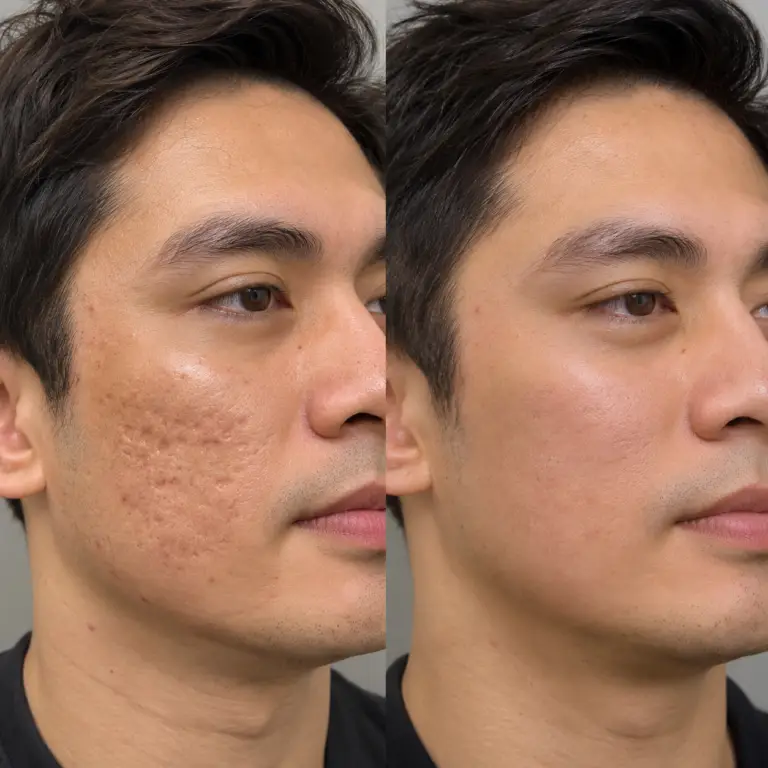
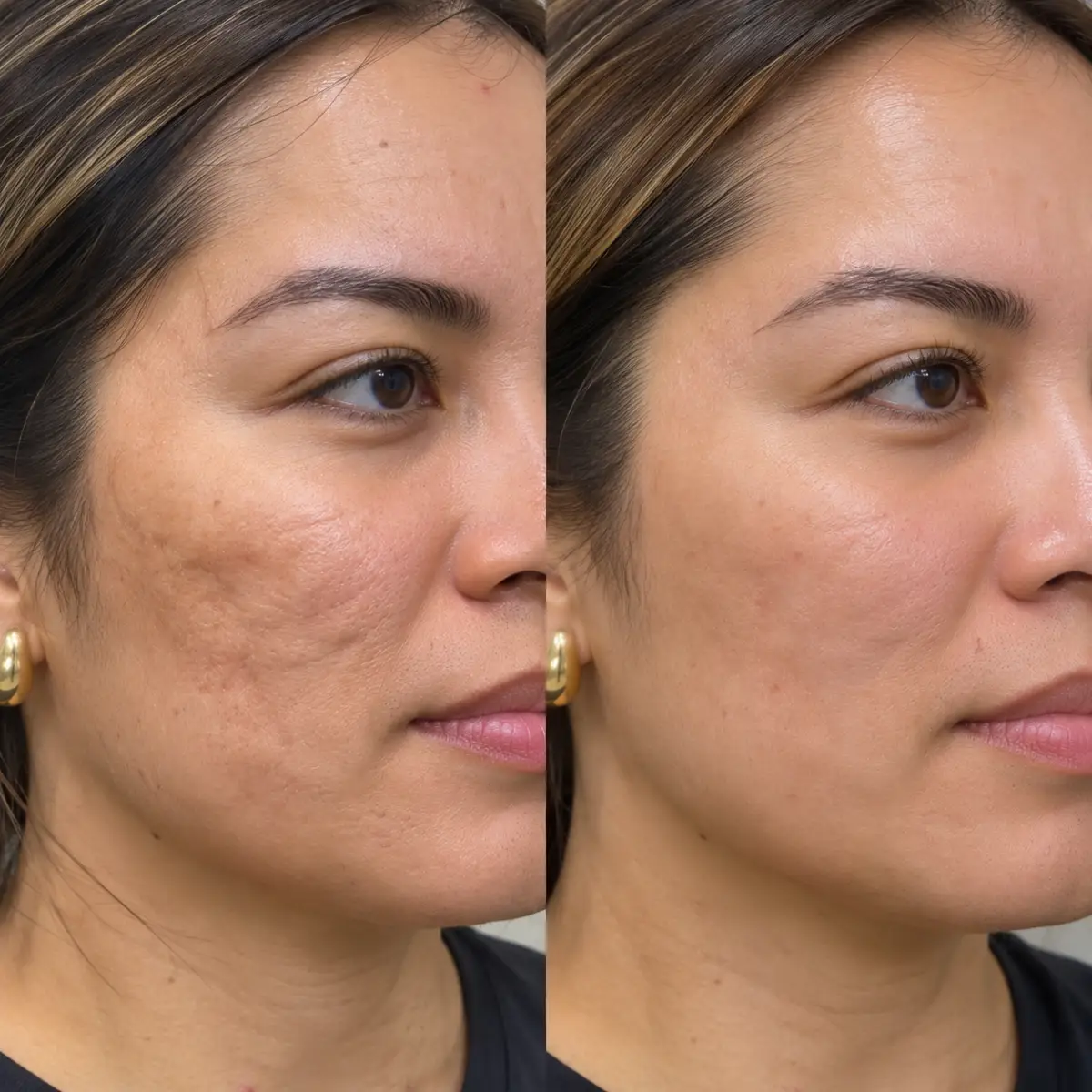
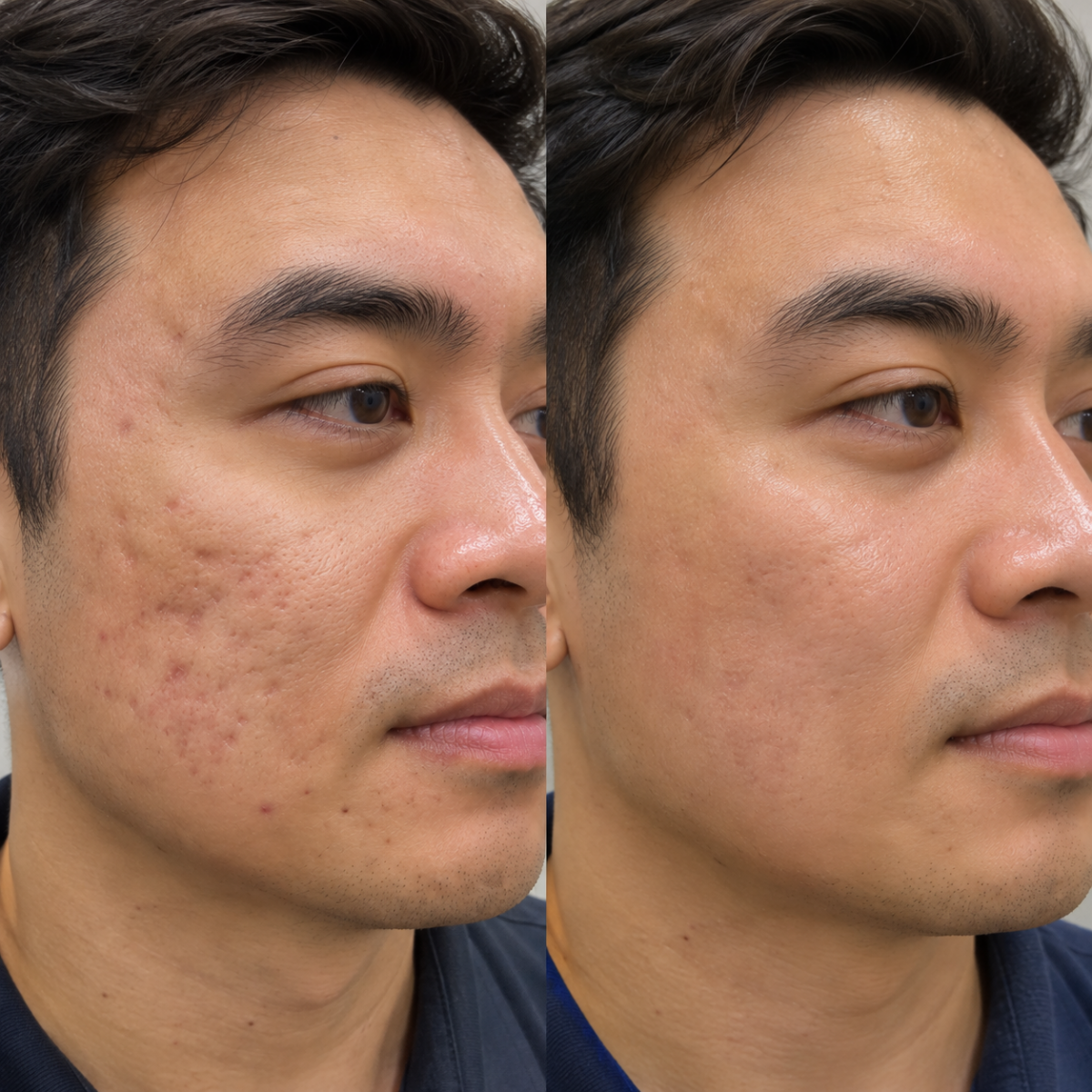
Laser Acne Scar Treatment Before and After: What to Expect
Frequently Asked Questions About the Best Laser Treatment for Acne Scars
Fractional CO2, Erbium YAG, and nonablative fractional lasers are among the options for selected depressed acne scars. The best choice depends on scar type, skin tone, and individual needs.
Erbium YAG may improve selected depressed acne scars through controlled resurfacing and collagen remodeling.
Some evidence suggests fractional CO2 may produce greater improvement for certain scars, but it may involve more pain and downtime.
Conventional Q-switched pigment-targeting treatments are not generally the preferred approach for deep depressed scars.
IPL may improve selected post-acne discoloration but is not generally used to correct deep scar depressions.
Deep ice pick scars may require targeted procedures such as TCA CROSS or punch techniques, sometimes combined with resurfacing.
Subcision may be useful for tethered rolling scars. Resurfacing or other procedures may be added when appropriate.
Selected boxcar scars may improve with fractional resurfacing, Erbium YAG, or other appropriate procedures.
Lasers may produce lasting improvement, but complete removal cannot be guaranteed.
Session count depends on scar severity, device, treatment intensity, and individual response.
Improvement may develop over weeks or months as the skin heals and collagen remodels.
Discomfort varies. Some procedures require topical anesthesia or other comfort measures.
Yes, particularly with ablative treatments. Recovery depends on the procedure.
Complications such as burns, pigment changes, or additional scarring are possible.
Selected treatments may be appropriate, but some lasers carry increased pigment-related risks in darker skin tones.
Neither is universally better. The appropriate choice depends on scar characteristics, skin tone, and recovery preferences.
PRP may be used alongside selected procedures, but its benefits vary by treatment protocol.
Existing scars may remain improved, but new acne breakouts can create additional scars.
Acne scars involve structural changes in the skin, while dark spots often represent post-inflammatory pigmentation.
Dr. Lift Spa is located in Grapevine, Texas, and welcomes patients from Southlake and nearby communities for consultations about available aesthetic treatments.
Acne Scar Laser Southlake TX is an FDA-approved treatment for cosmetic use, widely recognized for its safety and effectiveness (learn more from the FDA).
Looking for the Best Laser Treatment for Acne Scars Near Southlake, TX?
Choosing a treatment for acne scars begins with identifying the type of scarring.
Patients with depressed scars may need resurfacing or other scar-directed procedures.
Patients with discoloration may benefit from a different approach.
Dr. Lift Spa is located in Grapevine, Texas, and welcomes patients from nearby communities, including:
Grapevine
Southlake
Colleyville
Keller
Flower Mound
Coppell
Bedford
Euless
Irving
The clinic is physically located in Grapevine, not Southlake.
Schedule an Acne Scar Consultation at Dr. Lift Spa
Acne scars can affect skin texture long after breakouts have resolved.
Understanding your scar type and available treatment options is the first step toward developing realistic expectations.
Whether you are exploring Erbium YAG resurfacing, microneedling, or other skin treatments, a personalized consultation can help determine which services may be appropriate.
Dr. Lift Spa — Grapevine, Texas
Serving Southlake and surrounding Dallas–Fort Worth communities.
Phone: 817-214-2582